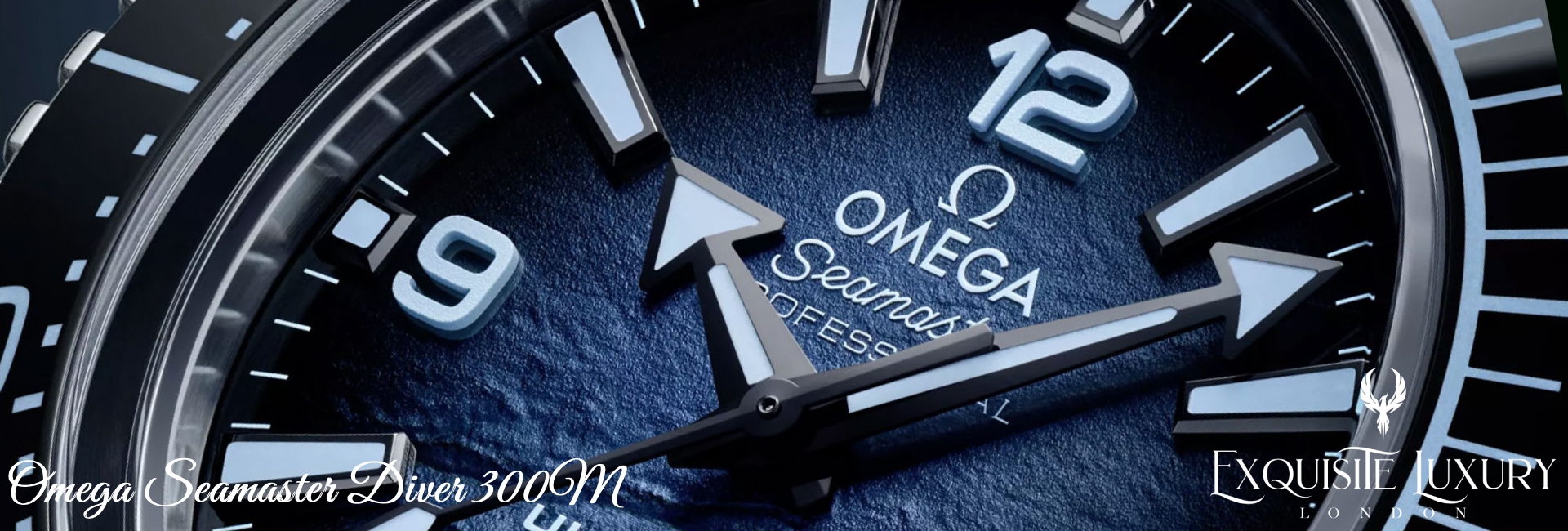
The Heritage Tier Part 2: Omega Seamaster Diver 300M
The Unassailable Icon of the Deep
When we discuss the pillars of The Heritage Tier, few timepieces command the same recognition as the Omega Seamaster Diver 300M. It is a watch that doesn’t just lean on its Seamaster legacy; it actively pushes the boundaries of what a modern Master Chronometer should be. While competitors often hide behind vintage aesthetics to mask technical stagnation, Omega has doubled down on innovation, integrating the Co-Axial escapement into a package that remains arguably the best value-for-money proposition in the high-end market. Even the divisive helium escape valve, often debated in enthusiast circles, stands as a defiant symbol of its professional-grade intent. This is not a watch that seeks permission to be at the top; it is a watch that defined the very category it occupies. As we explore the evolution from its 1993 Bond watch heritage to the ceramic marvels of 2026, we find a timepiece that perfectly balances historical weight with the absolute pinnacle of silicon balance spring technology.
The Bond Factor: More Than Just Product Placement
To understand the Seamaster’s ascent into The Heritage Tier, we must revisit the mid-1990s. Before 1993, Omega was in a different place. The Seamaster line was respected, but it hadn’t yet become a cultural juggernaut. That changed with the Reference 2531.80 and its appearance on the wrist of Pierce Brosnan’s James Bond.
Critics often dismiss the Bond connection as mere marketing. However, in the watch industry, marketing is the fuel that preserves history. The “Bond Watch” provided the Seamaster with a global platform. Few other high-end divers could dream of such a reach. It transitioned the watch from a professional tool into a piece of wearable pop culture. Unlike other brands that would have rested on those laurels for thirty years, Omega used that fame to fund a technical revolution. This eventually left many of its rivals in the dust.
Technical Supremacy: The METAS Standard
If the TAG Heuer we discussed in Part 1 is the “new entrant” to the Heritage Tier, the Omega Seamaster is the “Professor.” The introduction of the Master Chronometer certification was a watershed moment for the industry. While COSC certification—which we praised in the Aquaracer—is excellent, Omega’s METAS testing is a different beast entirely.
A Seamaster Diver 300M is tested not just for accuracy in five positions. It is also tested for its resistance to magnetic fields up to 15,000 gauss. In our modern world, magnetism is the silent killer of mechanical accuracy. By using a magnetic-resistant calibre and a non-ferrous silicon balance spring technology, Omega has solved a real-world problem. It is this level of “over-engineering” that justifies its status. You aren’t just buying a pretty dial; you are buying a piece of lab-grade equipment.
The George Daniels Legacy: Co-Axial Escapement
The heart of the Seamaster is the Calibre 8800, featuring the Co-Axial escapement. Invented by the legendary English watchmaker George Daniels, this system reduces friction within the movement. This leads to greater long-term reliability and longer service intervals.
When Omega industrialised the George Daniels friction-free system, they took a massive risk. It was a complex, expensive move that required entirely new manufacturing processes. Today, that risk has paid off. It gives the Seamaster a technical “soul” that is unique in the Swiss landscape. When you look through the sapphire caseback, you are seeing the most significant advancement in mechanical watchmaking of the last century.
Ceramic Engineering and Dial Depth
The visual identity of the Seamaster is anchored by its laser-ablated ceramic dial. The iconic wave pattern, which disappeared for a few years in the early 2010s, returned with a vengeance in the current generation. Because it is carved into polished ceramic, the waves have a depth and luster that no painted dial can replicate.
Furthermore, the helium escape valve at 10 o’clock remains the watch’s most discussed feature. Does the average wearer need a conical decompression valve? Almost certainly not. Saturation diving is a niche pursuit for a tiny fraction of the population. However, from a design perspective, it serves as a “visual anchor.” It makes the Seamaster instantly recognisable from across a room. This stubborn adherence to its Seamaster legacy is refreshingly authentic. In a world of “me-too” dive watches, Omega dares to be different.
Bracelet Ergonomics and Utility
If there is a common critique of the Seamaster, it is often directed at the bracelet. The “Tank Tread” five-link design is a polarising affair. It is unapologetically 90s in its aesthetic. While this fits perfectly with the Bond watch heritage, it can feel a bit busy compared to a standard Oyster-style bracelet.
Nevertheless, the quality of construction is undeniable. The clasp, featuring a patented rack-and-pusher extension system, is one of the most comfortable on the market. It allows for micro-adjustments that ensure the watch stays perfectly balanced on the wrist regardless of temperature changes. For those who find the steel bracelet too “retro,” Omega’s factory rubber strap is widely considered one of the best in the industry. It integrates perfectly with the case lugs to create a seamless, sporty look.
The Real-World Performance of the 8800
To truly appreciate why this watch sits in the Heritage Tier, we must look at the 8800 movement’s daily performance. Unlike older movements that fluctuate based on how much power is left in the spring, the Master Chronometer maintains its pace until the very end. The use of a free-sprung balance and a silicon hairspring means that the watch is incredibly shock-resistant.
Precision is the core of the Seamaster legacy. During METAS testing, the watch is subjected to temperatures that simulate both the freezing depths of the North Sea and the heat of a tropical beach. This ensures that whether you are at your desk or 300 meters underwater, the time remains true. Such reliability is what separates a fashion accessory from a professional instrument.
Market Position: The Value Proposition
In 2026, the luxury watch market is facing a reality check. Prices have spiralled, yet in the Seamaster Diver 300M, we still see a watch that offers a Master Chronometer movement, a ceramic bezel, and a ceramic dial for a fair price. It significantly undercuts its neighbours in the “Big Three.”
Omega has managed to keep the Seamaster accessible enough for the successful professional, while technical enough for the jaded collector. This model represents the ‘Goldilocks’ of the Seamaster legacy, sitting perfectly between utility and luxury. It avoids the stench of the over-inflated asset bubble by remaining, at its core, an honest and high-quality Swiss watch.. This balance is exactly what defines a Heritage Tier timepiece.
Comparing the Tier: TAG vs. Omega
In Part 1, we saw how TAG Heuer is using the Aquaracer to climb into this echelon. While the TAG is a fantastic modern tool, the Omega represents the “End Boss” of the mid-tier. The Seamaster provides that extra layer of horological “weight”—the METAS certification and the Co-Axial escapement—that justifies its slightly higher entry price.
Where the TAG Heuer is sharp and avant-garde, the Omega is curvy and technically dense. They are two different interpretations of The Heritage Tier. However, they both share an obsession with proving their worth through specs, not just stories. They are watches built for people who care about what is under the bonnet.
Versatility in the Modern Wardrobe
One of the reasons the Seamaster thrives is its versatility. It is one of the few premium aquatic timepieces that looks as good with a suit as it does with a wetsuit. This “go-anywhere” capability is a requirement for this tier. It needs to be a companion for life’s biggest moments.
The skeletonised hands and the scalloped bezel give it a dressy flair that more utilitarian divers lack. Moreover, the lack of crown guards on the HEV makes it look more architectural and less like a standard block of steel. It is a design that has aged gracefully, moving from the “cool new thing” of the 90s to a genuine classic today.
Maintenance and the Long Game
A key pillar of the Heritage Tier is the ease of ownership. Omega’s use of the Co-Axial escapement allows for extended service intervals, often reaching 8 to 10 years. This is a significant advantage over watches using traditional Swiss lever escapements.
When you invest in a Seamaster, you are investing in a low-friction future. This technical longevity ensures that the watch remains an asset rather than a liability. It is a timepiece designed to be passed down. Such endurance is the hallmark of any watch worthy of its heritage.
Final Thoughts: Why it is Worthy of The Heritage Tier
The Omega Seamaster Diver 300M is not just a watch; it is a benchmark. It earns the title of The Heritage Tier because it refuses to choose between its past and its future. It honours the Seamaster legacy and its Bond watch heritage without being shackled by them.
Every component, from the conical decompression valve to the George Daniels friction-free system, serves a purpose. It represents a brand at the height of its powers—confident, innovative, and technically superior. In a market often driven by hype, the Seamaster stands as a testament to real-world excellence. It is the definitive modern dive watch, a mechanical marvel that remains as relevant today as it was thirty years ago. If you want to know what a “Heritage Tier” watch looks like, look no further than the waves on this dial.
The Seamaster may be the technical master, but tomorrow, we look at the Patriarch. Can the Rolex Submariner justify its crown in 2026? Part 3 drops at 13:30.
The Seamaster Diver 300M: Precision on the surface, power in the depths.
- The Heritage Tier: Why These 3 High-End Divers Are the Ultimate Daily Icons
- The Heritage Tier Part 1: TAG Heuer Aquaracer Professional 300
- The Heritage Tier Part 3: Rolex Submariner Date